(This is the first in a series of articles outlining the process I created to take myself from a 23-year-old from an impoverished childhood with limited professional prospects to a multi award-winning advocate and executive recognized as one of San Diego’s 500 Most Influential People. I hope you find this as useful as I did.)
I’ve been teaching people how to effectively plan their professional, educational and personal pursuits for more than a decade and have had the pleasure of working with literally thousands of people from all walks of life—college students and wanna be college students, early career professionals, mid to senior career managers and executives, transitioning military members, individuals experiencing homelessness and the formerly incarcerated, to name a few.
Here’s what they all have in common: Each is looking for a straightforward method for making difficult decisions in their life.
What do I want to do with my life? Is there a profession out there that speaks to who I am? What type of educational or vocational training should I pursue? How do I make good decisions that will allow me to give my family opportunities that I didn’t have?
These questions often arise at moments of life transition. Starting school. Having a child. Getting passed up for a promotion. Turning 40. Getting laid off due to a worldwide pandemic and economic downturn. Hey, there’s something that may sound current and familiar.
We all know that the world economy is suffering due to the COVID-19 pandemic and many people now find themselves underemployed or unemployed. As difficult as this moment may seem, it is the perfect time to reevaluate the path you’ve been on and to pivot if necessary.
Rather than jumping immediately into making decisions that could have far reaching effects—notably wasting precious time and money—I recommend that you start with a period of introspection. The first five steps in my Strategic Career Planning: A 10-Step Guide to Realizing Your Potential program will help you do just that.
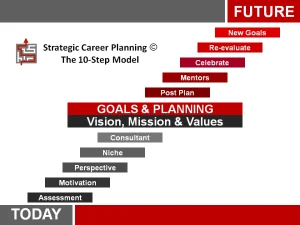
Step 1: Assessment
Know where you are starting and never forget it. This requires an exploration of your personal history. What decisions got you to this point, either those made by you or for you by those around you? Complete an inventory of the knowledge, skills and training that you have accumulated so far. The most important characteristic of this assessment—it must be based on an honest understanding of yourself. This initial assessment will form the foundation for a personal SWOT analysis (Strengths, Weaknesses, Opportunities and Threats) later in the process.
Step 2: Find Your Motivation
What is driving this change? Who are the people, experiences, topics or issues and ideas that are motivating this change? Are you motivated to prove something to a relative, or to yourself? Do you feel a disconnection from the path that you’ve been on? Have you failed to capitalize on a God-given talent or prior achievement? Have you perhaps made poor decisions in the past? Is there something that you’ve always been passionate about but have never pursued for (insert myriad reasons/excuses here)? Or do you never want to feel vulnerable again, as so many of us have during this sudden economic downturn?
Step 3: It’s All About the Angles
Do you have tunnel vision? Have you never stepped outside of yourself to assess your circumstances from a different point of view? It is important to look at your life and the challenges ahead of you from a new perspective or a variety of perspectives. New perspectives lead to new interests—and a better understanding of the issues. Use these new perspectives to envision a future of success and excellence.
Step 4: Find a Niche
What the heck is a niche? In short, a niche is something in which you can become a specialist. You might already be one and didn’t realize it. Most importantly, a niche is something that you can master, something with a future and something with flexibility. Ask yourself the following questions: What am I passionate about? Where do I have unique experience? What idea or job has a future?
Step 5: Consult a Trusted Friend
In the world of Strategic Career Planning: A 10-Step Guide to Realizing Your Potential, there are two levels of mentoring: Mentors and Consultants. We’ll talk about mentors at a later date. A consultant must possess certain characteristics. They must be successful. They absolutely have to be insightful, preferably about a number of subjects. And finally, it is imperative that they are pragmatic, sensible or realistic. When identifying a consultant, you must answer the following questions: Who gives me good advice? Who is honest and insightful? Who understands and listens to me? Who is my consultant and why would I choose them?
If you don’t currently have a consultant, do not hesitate to use me. I have mentored and served as a consultant for hundreds of people in your same position. I love doing it because I believe that each and every one has within us untapped potential that often just needs a little nudging to escape. Also, I believe in you.
I can be reached at aaron@galvanizedstrategies.com or on LinkedIn.
Stay tuned for our next article in which we will complete a personal SWOT analysis and learn how to write our Vision, Mission and Values Statements.